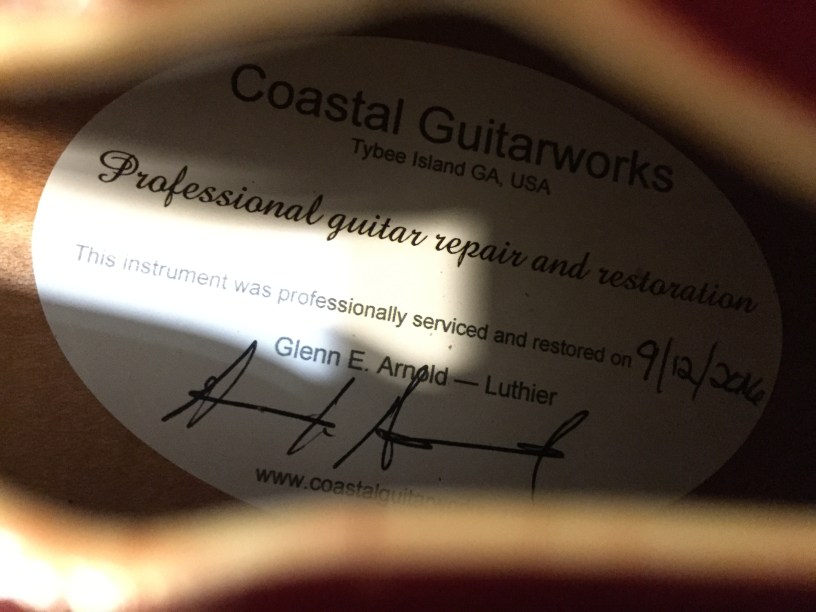
A cautionary tale…
ॐ
Table of Contents
- Preface
- Full Stop! No reason… No return
- Right livelihood
- Venn diagrams and rising tides
- “If you build it, they will come…”
- “Third time’s a charm… and a question of Fate.”
- “Tybeeitus” and the fundamental things
- “Everything gets a return.”
- And so it was that later…
Preface
This is the story of Coastal Guitarworks, the business I started… “a long time ago in a galaxy far, far away.” It is a true story, and truthfully told: a tale of what happened down in Georgia, where my wife and I sojourned in Tybee Island from 2012 to 2017. I have felt compelled to tell this tale partly for the sake of accountability; as I hope will become apparent upon completion. But I also offer it as a cautionary tale; on the whole an account of hard lessons learned, and how one becomes the better for learning them.
In every story there is a beginning, a middle, and an end. This story, the story of Coastal Guitarworks, begins at the place where it all ended.
Full Stop! No reason… No return
It was on the morning of March 29, my wife’s birthday, 2017 when we learned the owner of the beach condo we’d been renting for four and a half years in Tybee Island GA had passed away just the month before. An elderly gentleman who lived north of Atlanta. We did not know him well. The property was managed and leased by a reputable, competent local rental company on the island. Coincidently, the month of March was also when our annual lease was up for renewal; a process that worked seamlessly from year to year according to the “grandfather clause” of our lease agreement. This year, however, that seamless process was about to be irrevocably altered in a way that would decide the outcome of not only our future in Tybee, but the fate of the business I had built there as well as my career in lutherie.
The new year 2017 began in sadness with the death of our beloved senior dog, Sammy, on January 2nd. He lived some sixteen years as best can be estimated. He was a genteel tempered mixture of Rhodesian Ridgeback and some other large hound. I honestly never knew for sure how old Sammy was, since he was acquired as an orphaned puppy of no more than six or eight weeks of age in early February of 2001. He was the youngest of the two dogs I had raised together, a year and a half apart in age. The eldest, Sophie, a full blooded Sheltie, preceded him in death seven months prior in May 2016. She was just over 17 years when she passed, being preceded in death five months before by our house cat, Camille; who lived to almost twenty, then fell ill and died in December 2015. Both the dogs and the cat had been raised together, “siblings” of different species inextricably bonded to each other and to me. From the time Sammy was rescued to the time each passed away they enjoyed long happy lives together and brought much joy to our family. They were, without question, as much part of the family as our kids or grandkids. To lose them all so close together in something of a domino effect was a lot for me to process at the time. Clearly, 2017 would prove to be a year marked for change. Whether it would be change for the better or the worse remained in question; the answer being found portentously framed between avenues of circumstances to follow, and time.
It was the owner’s son, also from Atlanta, who called on that March morning with the news of his father’s passing. After offering our sincere condolences he proceeded to inform he had also “fired” the rental company from whom we leased the property. He then added he would be taking oversight of things going forward. This did not come as a total surprise to me. In the Fall of the previous year we had to evacuate Tybee during Hurricane Matthew (2016). During the evacuation I spoke with the son once or twice on the phone, mainly about the status of the property from the storm. During these conversations he intimated his by then infirm pappy wanted to dismiss the rental company. When I inquired why and expressed how appreciative Viki and I were to live there, and how well managed everything was, the response I received went not much further than something about money. Sonny related that daddy felt they weren’t seeing enough ROI against the cost of the managed broker agreement with the rental company. The response was clearly vague: signaling bad blood between the property owners and the owners of the company managing the property. What was clear was that it was none of my business to inquire; what was vague was where it might leave us as tenants should an executive decision by the owners become actionable with no firm middle ground left upon which to negotiate terms. So when the call came in March that his dad had passed and changes at the management level had indeed been made we were not much surprised; though needless to say we were a little concerned about what may lay ahead for us. We had no direct relationship with the son or his family. Having inherited the property, and the local rental company now out of the picture, what assurances would be given us that the terms of our lease agreement would remain intact as they had in previous years? Rather than draw up a new lease, however, he pitched the prospect of just allowing us to continue renting month-to-month indefinitely, all other things remaining the same. A gesture was made to sell the property to us; which I respectfully declined, and instead requested a 90 day notice should the home be put on the market. This he agreed to, and said he would be in Tybee to inspect the property the following week and to discuss terms more fully.
In a sit-down on Tuesday of the following week the terms discussed on the phone were reiterated and a “handshake deal” was struck in the living room of the condo. We took him on faith at his word. It was the first week of April 2017. On the morning of May the 1st he called again. We were at that time in Memphis TN visiting family. This time the call was to inform he had decided to end our agreement altogether and convert the property to a short-term vacation rental beginning June 1. No reason was given for the change of plans other than it was a “family decision”. A certified letter, he said, had been mailed to our address in Tybee informing we were to vacate and turn over the keys to the property by or before the first of the following month. We had been faithful tenants for four and a half years. Now we were being told by this new owner that we had exactly 31 days to vacate! This series of untoward circumstances set in motion the events that forced our relocation: which in turn issued in the immediate closure of my workshop and the untimely end of Coastal Guitarworks, my “dream business”.
Right livelihood
Losing the business in this way hurt almost as much as losing my beloved animals, and was no less difficult to process. More than a dream, Coastal Guitarworks was my brainchild. The idea of owning and operating a full service lutherie had been percolating in my mind for several years, even long before I worked professionally as a guitar tech, while I was still making my living in another career. Exactly when, where, and how I was going to make that idea happen was unknown to me at that time. All I knew was that I wanted to be involved in making guitars, and I believed lutherie was something for which I’d be well suited. It was clearly more presumptive at the time than it was pragmatic, especially since I had never actually made a guitar before and had only very limited skills acquired through maintaining and modifying my own guitars, and sometimes those of friends and bandmates over the years. Prior to lutherie I enjoyed a very long professional career (over 25 years) in the field of Information Technology. About half of those years I was employed as a network engineer, working for Fortune 500 companies, and at one point operating my own consultancy for a few years. As it turned out I didn’t launch the lutherie owner/operator startup idea until age 57, having by that time accrued some years of professional guitar repair experience as well as completing a master level training course at a guitar building school near Atlanta GA.
After being employed as a guitar tech for a while I experienced a shift in focus in how I would approach the work. At the risk of sounding overly “Zen”, the mechanical process of applying acquired skills to fix guitars morphed into an intuitive approach to the instrument as being part of an organic whole. (So as not to be misinterpreted here: Yes, as a matter of fact you DO need to acquire some skills to fix guitars. No, don’t EVER use a client’s instrument to test your hypothesis about anything. That’s what demo builds and prototypes are for, as well as bottom-feeder guitars found on Craigslist.) This focus-shift is not as mystical as it perhaps sounds. I simply realized it is one thing to merely “fix” or mass produce guitars; and quite another thing to be able to understand how a guitar can be made or modified in such a way that as a result it becomes a vehicle of personal expression, truly inspiring for the player and a thing that invites him or her to play. I wanted to be able to produce that result in such a way that in the outcome whatever work was done it retained and reflected something of the “impress” — an Imagio Dei — of its maker and crafter. A lofty goal, and in order to pull it off I realized I had to somehow “get inside” the guitar. I needed to become (in the words of one of my clients) a “guitar whisperer“. Mystical experiences aside, I gained a new gestalt about how a guitar can be made, or made better, which in turn transformed my whole approach to lutherie as a discipline and an art form. Instead of merely following a rote process to fix or create a guitar — do this first, then do that — I now began to understand the instrument from multiple aspects of the same experience: where the guitar, the player, and the luthier are all working synergistically toward an intended outcome. After several years of doctoring and playing guitars, suddenly I started “hearing” what the instrument was saying about itself. The workbench became more than just a place to get work done, an operating table with a “patient” lying passively on top. It now had taken on the form of a supportive frame for a living thing, something that was a key operative in a thinking, responding, intuitively creative process. That process is one of becoming: a movement from the realm of abstract ideas and emotions taking form as a musical expression by the player.
Lutherie is on some level an artisan discipline. Like all work that involves a creative process, there is a certain amount of active intuitiveness required in order to do it consistently well. You have to listen carefully to what players are saying about their playing experience, what they like and what it is they hope to achieve performance-wise by having the instrument serviced. They may come with their guitar and say, “I want my action as low as it can go with no buzz!” This is such a common request for a setup objective it could be a price board item with a SKU in some repair shops. “SKU: SOLOW_NOBOW… $125.00”. But what the player is actually expressing here is that their guitar is uncomfortable to play and thus not very inviting. It’s not really as esoteric as it sounds. Players often want to get a slightly different voicing from the instrument than what they’re hearing currently. It’s a question of discerning what they want to hear and what they’re actually hearing, and then figuring out how to take the instrument there or if it is even possible to “get there from here” in its present state. Since “tone” is on some level an inherent characteristic to a guitar, and at the same time such a subjective experience to a player, discussions of this nature have a tendency to wander into the realm of guitar esoterica. Guitar techs are by nature a nerdy lot; but in reality there are no magic wands or pixie dust that can be waved and sprinkled to produce a delightful and expected outcome. If only it really were that simple! In a lot of instances players feel their guitar or bass plays comfortably and has “good tone” (NB: it’s subjective), but will express something is a little “off” in terms of tuning or intonation. Maybe all it takes is a couple of minor adjustments, or “tweaks”, to address the issue followed by a short consultative review of DIY periodic maintenance to keep the ship on course. Shop policy for me defined tweaks as anything taking less than 20 to 30 minutes bench time to correct. Tweaks were often free, and a good way to get repeat and referral business. Good customers don’t abuse it, and good techs don’t refuse it.
For a period of three years prior to starting my own business I did guitar repair for Guitar Center. When I hired on, the company was still in the pilot stages of its GC Garage℠ program. Even though I grew a respectable clientele during my tenure as a repair tech with GC, the somewhat rigid corporate culture at times presented an impediment to doing all the things I knew I was capable of doing. Coastal Guitarworks was “the next level” experience for me operationally because it presented the potential for more freedom and control over how the work would be done, as well as how the business experience might be executed and delivered. I now had the freedom to take in on a repair order virtually everything that came in the door. And I did just that, especially at the very beginning of the startup. As a result the shop quickly became known for custom setups and excellent fretwork, as well as for personalized service and a focused attention to detail. General maintenance services — restrings, setups, fretwork, electronics, etc. — represent the bread and butter of most busy repair shops, and Coastal Guitarworks was no exception. I also took on a respectable amount of advanced structural repair and restoration projects year in and year out. These might be projects that required finish repairs or complete refinishing. Guitars with broken necks and decapitated headstocks, acoustic guitars needing neck resets, bridges replaced and bracing repaired, and binding repair and replacement made up about one third of the business on a quarterly basis. As a solo operation with limited space, the more labor-intensive time-consuming projects were placed in a queue and worked into the shop rotation on a weekly basis along side the general repairs. Players understood that the more complex projects cost more due to the extensive time required to complete them satisfactorily. The goal is to return the instrument to its performance capability and aesthetic, with warrantable structural integrity, and manage to do that without much or any scope creep. I established reseller relationships with major suppliers, such as Allparts and WDMusic, and others, to keep the shop fully stocked with materials for repairs, cutting back the downtime that occurs when inventory needed to complete a project had to be special ordered. All instruments approved for repair were assigned an RO number that became an invoice number when the instrument moved through the system to completion. All repairs were delivered with a standard limited warranty, in writing, for whatever work was done.
The question always comes up: “What’s it gonna cost?” for this and that. It’s a fair question, and using a published price board for available services is a means of addressing and answering much of it. Determining what exactly is an equitable amount of money to charge for a product or service is not an exact science, especially if the project requires an advanced level of skill and a lengthy lead time to completion. Anyone working independently via appointment only, or running a bespoke custom shop can attest to dealing with this issue. It has to be dealt with fairly, in a manner that is mutually beneficial to client and service provider. I think a better way of asking the same question is by putting it this way: “How do I avoid exploiting other people for personal gain and still get a fair return for time and materials, while being able to maintain focus on the physical work and promote controlled growth?” And then how do I take that approach and make it work as part of my livelihood? I can’t speak directly here for every builder because I’ve made my living in Lutherie largely from offering repair services. (See section on “Venn diagrams” below.)
As a startup repair service, knowing what to charge a client for any given service offering can be easily resolved by “mystery shopping” your own market to find out what other shops doing what you do are charging for the same or similar services. I call this the comparative approach model, and it is relatively easy to do. One method involves posturing. In effect you call around to other shops in the region and act like you need a setup or a fret job, then ask them what it costs. Personally, I don’t advocate that tactic. It seems seedy and deceptive, and most places will just tell you “Bring it in and let us look at it” then give you their business hours. You can also go incognito with a guitar and visit those places that offer retail repair and free evaluations, and see what they tell you. It works, but that’s not my style either for two reasons: 1) It’s disrespectful to the retailer or shop owner whose valuable time is being wasted while you jack them off, all the while intending to go into business as a competitor. Bad karma all the way around with that one. And 2) Once you do launch and your competition gets wind of who you are, and remembers what you did, it can potentially besmirch your reputation as a retailer or service shop.
If you’re planning a startup lutherie service, whether the focus is doing repairs or making instruments, my advice to approaching a comparative survey is just have a conversation with local guitar players. Ask them plainly and respectfully what they pay when they go here or there for this and that, and what are their main expectations in terms of a business experience. The feedback received from players is typically real and often “non filtered”. That information can be used to build a realistic pricing schedule for whatever level of product and services your workshop can deliver to your market at the moment. A price board can be displayed as signage in the shop or store. Price scheduling can also be published on a website as well as on printed materials such as business cards, slick sheets and flyers. These can be handed out as marketing materials and included in guitar cases and gig bags with completed repairs. Customers who visit a shop, either via a professional website or in a brick-and-mortar building, or both, and see available pricing for products and services tend to feel more confident they are in a reputable professional environment. In a shop that primarily focuses on repair services, for example, a publicly displayed pricing schedule goes a long way and helps legitimize what you say you do as a repair professional.
Conducting a comparative survey analysis is a simple means of ascertaining what fair market value actually is for goods and services in any given regional market. “Economics 101”, right? There is another approach — what I call the intuitive approach model — which also attempts to balance market fairness (i.e. what can I get for this or that) against real costs for labor, operational overhead, payroll, materials, etc. — the “stuff” the IRS considers “profit and loss”, or P&L. By “intuitive” I mean taking the time to interview each customer with their instrument present, playing the instrument — more importantly, having the customer play their instrument if possible — and listening very carefully to both the guitar and the player while discussing the service objectives. That information will inform how best to meet the player’s requirements within the realistic bounds and physical limitations of the guitar, the client’s budget, and one’s own rightly assessed crafting abilities.
For as much as an intuitively conducted interview is largely subjective and highly individualized, it can get tricky sometimes because this approach relates directly to a more spiritual and ethical side of determining what work well done is actually worth. Specifically, it confronts head on any temptation by either party to be led by greed or a desire to exploit someone else for profit and gain. Another reason why I believe this approach is vitally important to understand is because it represents the “purest” approach to crafting the guitar and holds the most potential for integrity to will out in the service/client business relationship. Whatever information is gathered from an intuitive approach is useful to the luthier in order to correctly discern what remedial efforts can be applied to fix the guitar and improve the player’s experience, and of no less importance whether or not the cost of those efforts justifies the value of the instrument. Sometimes the cost of replacing a guitar is less than the cost to have it repaired. In my view honesty really is the best policy here. The question of what determines value in the mind of the customer is a discussion best had with each customer after an honest evaluation of the instrument has been done. In any case, integrity at the workbench, as well as business integrity, are two components that always function as a hand-in-glove dynamic. It is in that dynamic the business relationship between crafter and client is being served and validated.
It is a very simple principle. When applied to guitar making or repair as a creative service it works thus: Serve the instrument and you’ve served the player, and vice versa. What I’m talking about here is an intuitive skill, difficult to teach but imperative to learn and incorporate into one’s process. It is an approach that has best enabled me to focus on the physical “nuts and bolts” work in a more organic way, and still run a business with any kind of fair profit motive in view. The “business”, in essence, is always facilitated by the work. Realism understands “you can’t please all of the people all of the time.” Using written quotes and offering signed service agreements goes a long way to protect both the customer and the service provider for bespoke projects, custom shop work, and everything done that is beyond scope of a general repair service. In any case, you can be reasonably assured that as long as you’re doing the work well and dealing honestly and fairly with the customer, the business will be validated via repeat and referral clients. It is a good idea, I think, to operate a repair service with an established pricing schedule for general line item services and still adopt a personalized “intuitive” approach to each repair issue as it appears. This gives the service provider the freedom and flexibility to quote pricing “off the board” when the situation calls for it, and still maintain market fairness with profitable growth in mind.
In Buddhist thought the principle of “Right livelihood” is incorporated in what is known as The Noble Eightfold Path. But you don’t have to be a Buddhist to appreciate and enjoy the benefits of living and working that way. When it comes to building and repairing instruments, be honest with yourself about your own abilities. Know what you can do, and what can’t or shouldn’t be done for that guitar. Establishing relationships with other luthiers of equal or more advanced skill is also a good thing to do. Much like in the medical arts community, it becomes necessary at times to confer with a colleague or have another set of eyes look at a problem. There are plenty of “how to” resources online these days as well as internet discussion forums, but nothing beats having a trusted mentor on hand to consult with when you need it. From my experience the luthier community is more like a fellowship. Help and mentoring is usually available for the asking. Just ask nicely and be respectful of other people’s time! Most successful luthiers who do this work full time stay busy. On the business side of things, putting “need” before “greed” does not necessarily translate as ignoring your profit margin. What it means is consciously seeking to do no harm and not exploiting others for profit and personal gain just because the opportunity presents itself, and you know how.
Right livelihood. As a discipline it is a wonderful transformative approach to living peacefully and successfully by any yardstick. It is an approach that I have incorporated into my own method of conducting business fairly and equitably. Could I live that way and be successful as, say, a stock broker or a banker? I don’t know. I’m a luthier not a stock broker. But I’ll tell you this. Our stock broker is an honest standup guy and our portfolio continues to grow and pay out ample dividends each month. Our house is in order, my wife and I enjoy our retirement, and we sleep well at night. You can’t take it with you, so if there’s anything left over after my ticket gets punched it goes down the line anyway, as it should. Right livelihood. Thanks, Buddha! Bro fist!
Venn diagrams and rising tides
Lutherie as a craft discipline is best illustrated by a Venn diagram. The term, “lutherie”, incorporates a vast knowledge base of information relevant to the practice of making and maintaining all stringed instruments: i.e. viola family, lute, bazouki, mountain, and the various designs of traditional guitar and bass instruments, as well as more cultural instruments like the guitarrón, the sitar, and a host of oriental stringed instruments. (For a more in depth study of the origins and history of the Spanish and Flamenco guitar, as well as a deep-dive technical discussion of how they have traditionally been made since the mid-19th century, I would refer the reader to Ervin Somogyi’s work, and specifically his 2-Volume set, The Responsive Guitar and Making the Responsive Guitar. ) Then there are the exotics, like the modern harp guitar, and even reproductions of ancient stringed instruments such as the lyre. The predominate modern usage of the words luthier and lutherie, however, seems delimited to those who design, construct, and/or repair and restore guitars, banjos and mandolins (“mountain” instruments) and the viola family. In the context of modern guitar repair and guitar making, the circles of “repair tech” and “maker” overlap such that information accrued from hundreds of hours of repairing a wide variety of guitars becomes useful to enable elements of design and construction that can be leveraged to produce responsive instruments of very high quality. On the other hand, and not surprisingly, where makers having achieved a level of mastery in their craft have been surveyed about their background, in a great many cases the common thread reveals they also had a marked degree of depth and experience repairing and restoring guitars before establishing themselves as makers of guitars. Frankly speaking, an accomplished guitar repair professional will almost certainly be able to build a high quality performance-ready guitar from scratch.
So there are (at least) two sides of the lutherie coin, and they are not necessarily exclusive of each other. For simplicity I’ll refer to “guitar makers” and “guitar techs” as separate and distinct disciplines under the same umbrella of the Lutherie Arts in general. I have had opportunity to survey several established Guitar makers. In nearly all cases before becoming established as a guitar maker, working as a guitar tech doing repairs was necessary in order to make a living while building their “Maker” chops at the workbench. Likewise, I carved a niche in the Lutherie trade with an emphasis on general and advanced repairs, custom modification, and vintage restorations; building guitars remaining on the back-burner in deference to managing repair workload, and to ensure sufficient cash flow to meet the shop overhead requirements of operating an SP business. Regardless of focus, be it repair or building, whether the approach taken involves the use of low-tech hand and power tools, or a more modern high-tech approach using CAD design and computer numerically controlled (CNC) platforms for fabrication of bodies, necks and sub-assembly pieces and parts — or a marriage of modalities — the outcome must facilitate the same objective: delivering a durable, responsive instrument that is enjoyable and inspiring to play. Whether the players who brought their instruments to me were beginners or seasoned pros, it made no difference to me. I came to see my role in the repair service process as something of a matchmaker, where the sum total of all remedial objectives was to serve one goal: that the player and her or his instrument fall madly in love with each other and make beautiful music together! In this respect Coastal Guitarworks became successful as a place players could trust and count on for consistently high quality repair, modification, and restoration of their instruments.
It was while still living in Madison Mississippi that the plan to actually launch the sole proprietor workshop slowly came together. As mentioned earlier, I was at that time working full time for Guitar Center managing a repair shop within a local GC store in Jackson. In Q3 of 2009 the company began rolling out their GC Garage℠ in-store repair program throughout their market chain. I had been asked by a close friend, who was in those day general manager of the Jackson store (#790), if I would be interested in coming on board for the purpose of launching and establishing a permanent in-store repair shop presence. I accepted that challenge on condition that my tenure would be limited only to a launch and an initial service period of no more than 9 months with the company, after which I would then be passing the baton to someone else and returning to my goal of starting my own shop under my own name. This was agreeable to corporate management, a non-compete agreement was signed, and I went to work for Guitar Center in January 2010. Only it wasn’t for nine months. The repair shop evolved into a very busy service center that was routinely taking in repair orders from a tri-state area as well as for the regular local customer base. That nine month initial service period came to an end almost three years later! It wasn’t until late November 2012 that I was finally able to pass the baton and roll off in order to pursue my own business plans. The time spent working in the shop at GC left me with a keener sense of how to market myself (and how not to market myself) as a professional repair service operation. By the time I left the building of “corporate guitar repair” I pretty much had the entire business plan for my own workshop white-boarded on the wall of the home-office upstairs in the townhouse we were renting in Madison MS. I had a good idea of how I wanted my next shop to operate, what my DBA would be, and I knew where I wanted to launch.
My wife and I were married in Savannah Georgia on October 18 of 2010, nine months after I started the workshop at the Guitar Center. Neither of us had ever visited Savannah before. We had no direct connection to the city itself, and what we did know of it was purely by reputation of its purported charm. Ours was a simple civil ceremony conducted by a local officiant in front of the iconic Fountain in Forsyth Park, the perfect place to stage a wedding on what turned out to be a beautiful Fall afternoon. From that initial magical encounter with Savannah we fell in love with the city, and it was upon this impulse that the egg was laid to pull up our tent pegs in Mississippi, relocate and begin a new life together in this enchanting jewel of the South. From the time we got married until actually moving from Mississippi to Tybee Island in December 2012 we did our due diligence in an entrepreneurial spirit. We took four business-vacations to the area over a period of twenty six months, each time with the notion to prospect the area in an attempt to discover its potential as a possible location for a new start-up. We visited venues, talked to guitar players and musicians in general, and offered business cards and service literature already bearing the marks and logo of what was to become a new and exciting venture. Savannah proved to be clearly a musical city with an amazingly diverse mix of talented musicians and bands. I thoroughly enjoyed every minute of connecting with these local artists, discussing their music and gaining an understanding first hand of what their needs and expectations were in terms of servicing and supporting them and their instruments. The encouragement and enthusiasm shown by the players when learning of my plans to launch a start-up in the region validated and energized the prospect of relocating. It was confirmation to keep going and see it through, calculating the risks without ignoring the responsibility and commitment we were about to make by this undertaking.
It is my belief that the prospect of reward for a service well done inherently extends beyond the one providing it. If a person is paying for a product or service then they are entitled to expect said product or service will in some way add value, if not also potentially improve, their overall experience. Else what’s the point of even offering anything to them at all? “A rising tide lifts all boats!” Coastal Guitarworks was, as I mentioned, my brainchild. It was my name and the work of my hands that would be on the line here. People talk. And when they do, it is always your work, and how you treat those for whom you do it, that will tell on you; whether it be good, or mediocre, or just plain useless. This principle is never more relevant than in an artisan discipline like the Luthier arts. I came into this work to do the exceptional. I made this my personal constitution — my mantra — from the beginning. Anything less, in my mind, was just not worth the effort. Personally there is always room for improvement; professionally, however, there is never any space for getting anywhere here by “faking it”. There are some professional disciplines that can be undertaken with a “fake it ’til you make it” approach. Lutherie as a profession is not one of them.
“If you build it, they will come…”
We moved to Tybee Island, the outer most barrier island off the coast of Georgia, on December 1st, 2012. That first winter in Tybee we rented a beach house at an affordable winter rate. The migration was an exhausting ordeal. There was the pre-trip planning. We sold or gave away nearly all of our personal furniture to lighten the load. This took less than two weeks. Even so we still managed to pack an eighteen foot rented moving van as well as our own two vehicles. The trip itself took almost thirteen hours to complete. We were moving ourselves, our two elderly dogs, and a very senior cat in caravan fashion. Since we had three vehicles — an SUV, a sedan, and the rented van — our youngest son was enlisted to assist my wife and me with the driving. We arrived at our destination well after dark, road worn and exhausted, and crashed for the night. The next morning we unloaded the boxes and crates filled with the stuff of our lives into the new digs, after which the plan was to just kick back for as long as possible, dig the sea breezes and the beach, and explore our new island habitat and lifestyle.
The day after Christmas I decided to run a Craigslist ad to announce my presence and introduce myself to the musical community. One of the first responses was an email from a local guy inquiring about a job and asking if I could hire him; and if I did he assured me of his ability to repair guitars as well as bring in a lot of new business since he also played in a local band. I was flattered and amused, but graciously had to decline his offer. I thanked him for his interest and explained we had just moved to the region and were presently on vacation, and I expected to be up and running with a fully operational workshop by or before end of Q1 of 2013. I suggested he might check back then or at a later date if still interested. Point of fact, all of this was quite true. The actual business plan I had drafted back in Mississippi projected an initial startup date of March 31, 2013. But in December when this guy came looking for a job after seeing the Craigslist announcement, I didn’t even have a website up yet! In any case, even though I wasn’t really considering a partnership for a start-up, I took his inquiry as a good omen. Other emails came, inquiring about making appointments for this and that. So by January of the new year I began taking in business on a limited basis at the beach house, using one of the spare rooms to do basic remedial services like restrings and setups, electronics and hardware upgrades, as much as the few tools I had unpacked from storage after the move would allow me to do. Very humble beginnings for sure.
The three month winter rental agreement on the beach house was nearing its end, and come February we began canvasing for a permanent location. I was restless and wanted to get back into my work routine. It was, after all, a large part of the basis for why we moved here. In March of 2013 we signed a long term lease and moved to a spacious fully furnished three bedroom condo, still on the island, but not directly on the beach. The condo was three stories, the ground floor being perfectly suited for a functional workshop with very little modifications needed to accommodate. It wasn’t long after moving in that a steady stream of business was beginning to flow into the burgeoning shop; the “first fruits” of due diligence beginning to appear. Save for that one Craigslist ad, I never advertised the entire four and a half years we resided there. Our venture was completely funded at our own expense, and we tapped the coffers for all they were worth to get off the ground to a successful start. I brought shop tools from Mississippi, but was unable to bring all of the machinery, like band saws and planers, and such. So I would start “low-tech” with only basic hand tools: routers, block planes, sanders, chisels, a drill press and bench sander, and several homemade tools I’d gotten used to working with over the years. Michael Greenfield once said, “You can build a lot of guitars with a #5 (block plane) and some sharp chisels!” I can’t say for sure if he was speaking for himself, but he certainly has made some amazing instruments over the years! So there would be machinery to source and purchase, then set up after it was delivered. Lumber and materials for workbenches, which I fabricated myself, as well as functional wall space for organizing and hanging tools and jigs, was needed first.
With limited budget resources the initial operational challenge was figuring out how to offer a wide spectrum of repair services in the most efficient way, leaving room for growth. I had attended a lutherie school well before ever thinking about moving. Part of that training was spent learning how to setup a fully functional micro-builder workshop within a limited space environment. Think garage or basement, or a small studio. It is one thing to have the skills to build and repair instruments and quite another to know how to launch a legitimate, credible business and make a living from it. Both skillsets are required, whether one’s goals are large or small scale production. I recall hearing Kent Everett expound on this issue of workshop operations models in an interview from several years ago featured in American Lutherie, the quarterly journal published by The Guild of American Luthiers. To paraphrase Kent… “You are always building three things at the same time. 1: You are building the guitar. 2: You are building the process that produces the guitar. And 3: You are building the facility that supports the process that produces the guitar.” This is arguably the most concise, incisive, and all inclusive clarification of a business operations model that I’ve ever heard having to do with making guitars for a living. It applies in principle no matter if one builds bespoke instruments one at a time or mass produces units chucked out by the hundreds or thousands per year. Kent has produced amazing handmade acoustic guitars over the years at Everett Guitars, his home workshop in the north Georgia mountains. They are just stunning! I suppose the practical wisdom offered by Everett’s keen insight about workshop production could extend to building anything. As it happened, Coastal Guitarworks would be launched on a shoestring budget. So the objective was figuring out how to keep quality high and overhead low, while investing as much of the profit as possible back into the operation, promoting growth and, hopefully, sustainability. I refer to this modality of operations as “the low-tech of high-craft”, and in theory it can be applied to anything you desire to make. Like Aeosop’s fable of The Tortoise and the Hare, sometimes “slow and steady” is what wins the race!
By April of 2013 word had gotten out that there was a new kid in town. And fortunately the word was good. I had budgeted for, and purchased professionally managed web hosting services and a registered domain. But the cost of paid advertising starting out seemed out of reach. Word-of-mouth advertising was the “best” way to go in my case and in general is an effective method of advertising, well suited for launching any small business, especially one involving a craft or artisan discipline. “The work will tell on you.” I had an advanced level of skills as a repair tech prior to moving to the Georgia coast. I had also by that time built a few handmade guitars of my own design, and was known for excellent craftsmanship as well as being able to provide a pleasant business experience for clients. But I had always worked in music store environments doing repairs. Now I was going my own way as an independent luthier. I wasn’t so concerned with the obvious risks of being an entrepreneur, most of which involve liability. That’s what E&O insurance is for. My focus was on earning the trust of the guitarist-musicians in a region where I would be seen as a relatively unknown quantity. It doesn’t matter what you’re able to “sell” people, or get them to believe you’re good for in terms of skill. Lutherie is a business based on trust. If you have a bad attitude or just don’t have the credibility to stand behind what you produce regardless of level of skill, people won’t trust you and won’t want to do business with you for long. I was fortunate in that I came to Savannah and Tybee as a dependable journeyman luthier, preceded by a reputation for very high standards of craftsmanship. I was confident in my skills and this took a great deal of pressure off feeling like I needed to “compete” for business. How does one compete exactly for business one does not yet have? I focused rather on building trust with the musical community right from the start. My attitude was, “Do the work, and let the work speak for itself.” This two-fold commitment to always doing excellent work and showing maximum respect for the players was the only M.O. that made any sense. And it paid off. Right from the start business steadily grew at my new home workshop. By third quarter of that year I was not only taking in direct business from the area, but had managed to establish a solid B2B relationship with one of the only two musical instrument retailers in Savannah at that time. By October I was looking for a new location to expand my services and popped the question to one of the owners of Georgia Music Warehouse.
Since June of 2013 GMW had been sending their customers’ repairs in batches to me on a weekly basis out on the island. I would go into Savannah on Fridays, visit the store and pick up as many repairs brought in during the week as I could turn around by my next run on the following Friday. I’d drop off completed repairs with the invoiced amount, pick up my check and a new batch of repair orders, and head back to my home workshop on Tybee Island. Since payment was due upon completion of the repairs I didn’t have to wait to be paid until the end customer showed up and remitted their payment to the store. I also serviced and maintained the store’s inventory of guitars. It was a good system and a sweet deal for everyone. The end customers received their instruments expertly repaired and turned around in timely manner. GMW received a healthy “cost plus” mark-up on labor at the register. I was paid directly by the store for my services, and I was able to control my shop’s workflow while still remaining free to solicit, service and retain my own clients independently of GMW’s customers. One may wonder, “If it was working so well, why change it?” It’s a fair question.
Many of those instruments coming from the retail store required advanced repair skills to turn them around, which I was happy to deliver. I had already shown what I could do. I wasn’t looking for a “job”. It was the store’s location that interested me. So the question being asked was: would the owners be interested in providing a suitable workspace to offer these services in house to their customers in exchange for a share of the repair revenues? The discussion amongst partners was had and a mutually beneficial verbal contractual arrangement was arrived at by all parties. They agreed to provide 200 square feet of sequestered floor space to build a workshop and perform repairs, in exchange for a cut of the house. I agreed to work onsite operating as an independent contractor during business hours, and not undercut the house by competing for business or working on my own projects while using the premises. It seemed a fair exchange at the time, even though nothing was put in writing. So on January 1, 2014, Coastal Guitarworks began operating from a new location in downtown Savannah at 2424 Abercorn St. This was now the second startup effort since moving to the region just thirteen months before. By April of 2014 business at the store was rolling in to the repair operation at an almost exhausting rate such that a six day, ten hours a day work week was necessary just to keep up with the workload and maintain a very high quality of services. The store was closed on Sundays and Mondays, but since I was a key-holder I often came in on these days just to be able to work uninterrupted. It wasn’t desirable, but it proved necessary in order to catch up on the previous week’s projects and get a jump on the week to come. Everyone was happy! The owners of GMW were happy. Their customers were happy. And I was ecstatic, albeit groaning under the increasing workload, as my “field of dreams” was becoming a fruitful reality.
The workshop at the music store continued to flourish. Revenues and profits for all involved steadily increased during that first year of operation on Abercorn in Savannah. By mid December of 2014, however, all this progress would take a 180 degree turn. Unbeknownst to me, divisions among investor/partners had been simmering all summer and fall, and were now coming to a boil and ready to erupt. Where once was order and structure within the operation was now infighting between some employee/associates and owner/operators. Much of the trouble, as best as I could understand it, involved unfounded suspicions on the part of two of the principals that a person or persons in the retail store were stealing money from the cash register. This quickly amped up and led to factions, paranoia, and deep partisan divisions that invariably overflowed into the operation, and onto the sales floor. This was a small, mostly family managed business, and the toxic roux that had developed now began affecting employee moral and production. Some people were terminated, others left of their own volition. I kept my head down, or at least tried to, and made sure that my profit center stayed profitable. What once was an environment of working professionals had now devolved into a zoo! Whatever synergy had existed amongst the workforce before had evaporated seemingly overnight. In its place was a cold-war zone with a surreal level of angst and paranoia attached that moved through the environment like an aggressive cancer. It became increasingly more difficult to maintain a healthy detachment and stay focused on the work I was doing there as a contractor. Customers were feeling it, too, and returned less and less to the store; which had deleterious effects on the overall revenue of the operation as well as my own paycheck. Per my standing agreement with ownership, my business remained “independent” of the store’s. My relationship to the store’s customers was consultative only. I interfaced directly with each customer personally concerning their repair needs, but I did not bill or collect monies directly from anyone. My billable “client” was GMW, the music store, which was being billed at cost for my labor and then collecting 30% (minimum) off the top of the retail price of the repair ticket at the register. “Cost, plus 30.”
By the time the new year 2015 arrived the writing was on the wall. It was clear to me that the music store was imploding, and the word around town had gone sour. One of the owner/partners had just been ousted in the last quarter of the previous year, and I learned a law suit was now pending against the company. There was also talk internally that the company might be coming under investigation by the local DOL and DOJ for misclassification of several of its workers, pending further investigation by the IRS. I learned later that of the almost two dozen employees who worked on the premises during business hours, only three people were actually classified as “W2 employees” by the IRS. They were a husband and wife, who where both vested owners, and one of their adult children. The rest of us were considered “gig workers” paid weekly or regularly on a 1099 status. Some of those workers, it was learned, were undocumented immigrants or working with expired visas or no “green cards”. The company was making beau coup dollar on the backs of its contract “employees”, sharing none of the employment tax burden or liability for healthcare or Workman’s Comp insurance (to which these workers all were entitled by federal and state law, since technically they worked on premises up to 40 hours a week). If you know anything about legitimately operating a company of any size you already understand that this “fast and loose” way of running a business, especially a small business, is more pervasive than is let on, and carries with it the potential for all kinds of questions to be raised concerning legality and legitimacy within the work place. Nota bene: This is an area to pay attention to if you’re going to strike hands in a B2B relationship with other small businesses. Big corporations have their own unique challenges in this regard, and typically maintain a cadre of “legal eagles” to navigate those murky waters. But in a small business environment this sort of sketchy operating modality gets amped up more readily, and becomes that much easier to flag should eyes on the outside start looking into things. And should that occur it can cast a shadow on all those involved, regardless of their affiliation with the company.
Since my credibility was invested with, and attached to their business enterprise I felt it necessary to dissolve my relationship with management and move Coastal Guitarworks off the premises. It simply had become neither a “safe” nor happy environment to work in any longer. Coincidently the remaining three owners — which included the husband and wife owner/operators, and a “silent” partner who was also primary investor — made a decision to change the name of the retail music establishment, though maintaining the same operating paradigm at the same physical location. In addition, the three principals had invested in a new start-up that would DBA a different name and function as a B&O distribution channel from another location. This new venture would in theory have no real tangible attachment or effect on the music retail business. The name change and start-up venture were clearly one of those “Ah! I saw what ya did there” moves to any observant eye paying attention to what was going on here.
It wasn’t until the end of Q1/2015 when I aired my own grievances about the goings-on of the past few months and the affect it was having on my business, my health, and my relationship to the enterprise as a whole. A mutual decision was made, the outcome of which issued in a complete dissolution of my relationship with these people and a separation from their shady operations. I came to realize I just wanted no more part of it or them. I completed any outstanding repairs, then dismantled the workshop, packed up all my tools and personal property, and moved out. It was 15 months of “high cotton”, a good run — until it wasn’t. But the cotton had turned rotten and was beginning to stink! Not surprisingly to me, and in spite of the name change for the music store, attempts to manage the retail business and expand their distribution business beyond the local level were failing to pan out. The retail store, now known as Musikhaus, closed and went out of business inside of a year after I left. As far as I know, as far as I could tell without really wanting to know, the former ownership was in the wind and of no further concern to me or my business. But at the time of my egress from 2424 Abercorn St., the decision to vacate created the dilemma of packing up my workshop, relocating, and trying to jump start my business venture yet again, intact; what would now be for the third time since moving from Mississippi to Tybee Island, GA. So in the first week of April 2015, with the help of four close friends, three of whom were also guitar players and customers, and the other a neighbor and close friend on Tybee, we managed to transport everything in three utility vehicles caravan style from downtown Savannah back home to the condo at the beach. After unloading everything in the huge three car garage on the ground floor of our rental home, it all sat there in boxes and crates for a month. I was angry. I was disillusioned with people and their perfidy. I was confused and second guessing my life decisions of the past three years, and I was doubtful if I could again successfully regenerate my business and my livelihood in this otherwise remote and untoward island environment. Most of all I was just exhausted and needed to rest.
Lo and behold, people called and people came, among them many of the clients whom I served at the music store downtown. Savannah is a city with a small town cultural mindset. Word got around I had left the store on Abercorn St. Folks sought me out on the island and continued to come with their instruments to be serviced. I was exhausted, but I needed to work. Moreover, I could not in good conscience refuse support to these wonderful souls, whose patronage and loyalty moved me at heart. I remembered my dream and renewed my commitment. I would reopen Coastal Guitarworks — for the third time — in May 2015, in the original location at home on Tybee Island. It was the right thing to do, if not the only thing I could do given the circumstances. I had an epiphany, a “religious experience”. I had signed no “non-compete” agreement, and I had a right to work. And this time, by God, I was going to do things my way! My “religion” was to trust myself.
“Third time’s a charm…
and a question of Fate.”
Before long business was viable again, and I was finding my “second wind”. Again. Or in this case my third wind. I had no way of knowing at the time, but waiting not much further up the path I was on was the series of events that would make this my last gasp as a luthier, at least for a while. At the moment, though, all I knew was I was operational again doing what I love to do, and with a stable income. Working directly now with clients on an appointment only basis enabled the same focused personal approach to the work with freedom from the tension and drama of the music store environment. Dealing direct worked to everyone’s benefit. With the middle man out of the mix I could offer services for less than retail; the client continues to get the highest quality services at a lower direct price point, with the assurance of faster turnarounds on general repairs. A “win win” situation for everyone! Not surprisingly, I was able to schedule projects much more efficiently and manage the workflow better. For the next two years I would operate this way, providing the full spectrum of lutherie services from restrings and setups to full instrument restorations, finishing, custom modifications, and all points in between. The brainchild I had labored so long to produce appeared! Coastal Guitarworks, now in its third avatar, was at last operating as a sole proprietor full service lutherie where no job was too small or too complex to be considered and accommodated. The third time really was “the charm”, and business continued to evolve steadily upward. Until it didn’t!
It has been said, “Life does not get better by chance, it gets better by change.” More often than not, I tend to believe this. I guess that’s why in the realism of life I find little room for fatalism. We tend to create our own luck. And surely as the sun rises and sets you can bet your bottom dollar on this one fact: things can and will change, with or without warning! In the continuous procession of life, change is the only real constant that remains the same. But change often arrives as a cruel and unforgiving teacher. And in the Spring of 2017, ready or not, school was now in session.
As said, my wife and I were in Memphis TN visiting family when in May, 2017, we learned our housing situation back in Tybee was now in total chaos. Six hundred and fifty miles away from home, with less than thirty days to vacate back in Tybee, and totally unprepared to move anywhere, whether it be local on the island or somewhere in Savannah, or any other place. We had only one play in hand: find someplace to move to immediately, and move! Which we did. We spent the first week of May apartment hunting, found a two bedroom apartment in East Memphis and signed a lease with a scheduled move-in date for June 1. Then we returned to Tybee. arriving home after nightfall on May 10th. We now had just 21 days left to gather up our things and vacate the condo at the beach. I scrambled to dutifully complete any repairs in progress that could be completed in time, and sadly informed those customers on the waiting list that “due to circumstances beyond our control” I would not be able to accommodate their orders. Deposits, if any, were returned. Then we hastily packed up our lives and most of my workshop stuff, rented a van and successfully relocated to Memphis, TN. The good news was that now in Memphis we could be closer to family again. Unfortunately, though, in the mix of all the changes there would be no provisioning for another workshop, not on the home front anyway; and renting shop space somewhere to facilitate another startup was just not financially feasible anymore. My tools and shop machinery, as much as I could manage to pack and transport, remained in storage upon arrival in Memphis. I had just turned 62 in March. If there was anything fortuitous in this otherwise dismal cloud of confusion and chaos it was found in my eligibility to begin taking SSA retirement in June of that year. Which I did. My lutherie career, now in limbo, became something of a focused blur. It would remain so indefinitely.
Rule number 2 of the “Four Rules for Success” comes to mind. “No matter what your chosen vocation, be prepared to work hard at it (at least some of the time), and be resilient in all circumstances. Allow yourself the freedom to change.” There is also a practical corollary: “When you’re renting, don’t get too comfortable no matter how long you’ve been there. Always have an exit plan!” Some additional important Life Lessons are offered here to anyone who’s paying attention. Such as: “When you strike hands on any business deal involving your time or your money, know who you’re dealing with and don’t leave the table until you get it in writing.
We had no exit plan. At age 62, whether I wanted to retire or not, I was now officially “retired” from the work force. Ironically, as diligently as we had planned our move to Tybee four and a half years earlier, there was no exit plan from Tybee Island. We were forced to move. And after all was said and done the expense of beach life and building a business out-of-pocket left just barely enough to make the necessary transition to a new place and a new life.
We left Tybee Island at dawn on May 31, 2017, with a packed rental van and our vehicles, caravan style, the same way we had arrived exactly one thousand six hundred and forty three days — or 4 years and 6 months — before. Our two elderly dogs and very senior cat had passed away the previous year.
I refer to those years in Tybee Island, GA, now as “the island years”, or more rightly, “the Tybee experiment”. In the years following our departure from Tybee I have had ample time to reflect on my time spent there; what it all amounted to, and why it likely never could have been more than it was. It occurs to me how incompatible island and beach life proved to be for my wife and me. Certainly it never measured up to what we had hoped and planned for, much less what we expected when we embarked on that exotic journey.
Maybe it was the constant annoyance of too many gnats and mosquitoes. Or perhaps it was the enervating triple digit heat indexes and 90% humidity for weeks into months on end. Then there were those long tourist seasons. Island economy more or less hangs or falls on tourist season. From May through October the island’s population explodes exponentially. Whether one is a permanent or semi-permanent resident, or a tourist on vacation, during tourist season it becomes nearly impossible at times to move about or recreate at all.
The main road in and out of Tybee Island is U.S. Highway 80. It is a two lane road traversing five miles of salt marsh between the Bull River and Lazaretto Creek, the borders of Wilmington Island and Tybee Island respectively. In summer during peak tourist season bumper to bumper traffic slows to a crawl at least twice a day as day-trippers from Savannah and other places, and locals working off-island, create a bottleneck coming and going. Some of the island locals refer to this stretch of Hwy 80 as “Death Alley”, because when the drunks wreck their cars, something that happens predictably during peak tourist season, it often results in fatalities. Even when it doesn’t, commuters can forget about arriving on time no matter which direction they are heading. Added to the aggravation of being stuck in traffic are the closures when the highway becomes flooded over at high tide. And when it rains, as it frequently does, the flooding is worse and takes longer to recede.
There was no hospital on Tybee in the years we lived there, not even an urgent care facility. There was a fire department with EMS services, but given the road conditions being often exacerbated by bottle necks and road closures due to traffic accidents or tidal flooding, God forbid a resident or tourist had a medical emergency requiring a hospital visit. The permanent resident population of the island, being about 3000 souls, consisted mostly elderly folk and retirees. The chances of someone having a heart attack or heat stroke on the beach, especially in summer, is practically a given. And when it happens it can be a death sentence, or at least a crap shoot with 50/50 odds of making it in time to the nearest hospital on the mainland in Savannah. This actually happened at least one time that I am aware of during our tenure as Tybeeneans. It involved a senior couple who, it so happened, were the previous tenants in the condo we rented, and where I would first launch Coastal Guitarworks on the ground floor. According to our realtor, the husband suffered a heart attack in the bedroom one evening and sadly died en route to the hospital in Savannah. An ironic and perhaps freakish circumstance, I grant, coming at the inception of our life in Tybee Island. I am not superstitious and I will not offer speculation about “bad omens”, etc. I’ll just say reality is a great teacher, and not so easily dismissed when things gets real. Such is the reality of living in an island environment with no close proximity to properly equipped health care and emergency medical facilities. People who define living the dream in terms of the “fantasy island” lifestyle need to give mindful consideration to the reality of that lifestyle on a daily basis, and on all levels, and count the cost before taking that plunge. And I think this advice is as wise as it is true!
“Tybeeitus”
and the fundamental things
In fashionably “unfashionable” fashion, living in Tybee Island ostensibly offers both a quaint and at times peculiar lifestyle experience. A small and relatively close knit community, people generally mind their own business — even while staying well informed through the grapevine of who’s doing what with whom. Tybee presents recreational opportunities for residents and visitors alike. Beach combing, collecting shells, surfing, paddle boarding, surf-fishing and offshore boating and fishing, as well as kayaking in open water and across the surrounding wetlands present a spectrum of exciting and relaxing activities. Islanders revel in Tybee’s cliquish bohemian neighborhood vibe, and celebrate Tybeenian events such as the annual Beach Bum Parade in Spring and the Pirate Festival every Fall, as well as other seasonal celebrations. As summer approaches droves of tourists flock to this sleepy beach community, swelling the island population exponentially. Some weekends the head count on island can clock as much as five to ten times the year round residential population, just over three thousand souls in 2020. The island thrives in a kind of economic co-dependency on tourism for much of its sustainable annual revenue. Yet there is a downside. Having so many live bodies collectively on a mound of sand with less than three miles of habitable space at one time presents no small challenge for residents and business owners alike; certainly not in the least for local law enforcement and other departments of city management tasked with the security, support, and management of an overwhelmed island population and its infrastructure. I am reminded of a line from a song about Tybee life written by a local songwriter, summing up the local mindset toward tourists and outlanders in general: “…We’re glad you’re here — now don’t stay too long!”
When stifling low-country summer heat combines with wall-to-wall people, marathon partying on beaches, city streets and in bars amplifies on Tybee. Community angst dials up in proportion to the seasonal rise in temperature and population, as recreational opportunities and finding space to decompress dial down. Island life in summer can often feel like being under self-imposed house arrest for many of the locals. You just resign to staying home and inside rather than dealing with the throngs of humanity and the sweltering beaches. From November through April, however, considerably milder temperatures and the relatively small residential population make for a more relaxed and tolerable environment. During the off season beaches become not empty, but nearly so, and mostly free of garbage and debris. You can drive on and off the island for the most part unhindered by fewer drunks in traffic and on the streets. Exploring island life or even just walking your dog is relaxing and energizing, while local eateries and watering holes promise a more relaxed and enjoyable environment to just hang out. Once tourist season is “on” and in full-throttle, however, dealing with island life can be enervating.
Like many tourist-driven American beach communities, Tybee’s beaches in summer could be either an invitation to “Margaritaville” or a doorway to mayhem depending on how the changes in latitude play against one’s changes in attitude. If the ritual of jockeying for a parking space, lugging ice chests, beach chairs, boomboxes, tents and umbrellas across two and sometimes three parking lots in hopes of finding a decent swatch of blistering sand upon which to squat, didn’t get to you — chances are the sweltering heat certainly would. In truth it was a combination of several things that squelched it for me finding much enjoyment in said surroundings. One man’s heaven is another man’s hell, so goes the saying. The egregious heat, the god-awful bugs, an insufferable tourist season, over-crowded beaches and bars, and just the overhead itself of living in Tybee proved enough of a deal breaker for me and my wife to realistically consider making a life-long commitment to stay. It was all these things. But fundamentally there was also something else, something deeper and not so easily identifiable at first.
There is a kind of lethargy about island life that creeps up on you after a while, a relaxed tension that emanates from being isolated too long in a place surrounded by water and mangrove filled wetlands, with little or no change of scenery or seasons. This, combined with the strangely cloying absence of euphoria in a place otherwise assumed to be “paradise”, created a disconnect between me and nearly everything I encountered in the island scene. It was palpable. In the Florida Keys they refer to this lethargy as “Key’s Disease”. In Tybee they call it “Tybeeitus”. It’s a real thing, and it is depressing; or at least that’s how it played on me.
Our exodus from Tybee Island was on the one hand stressful, yet on the other a balm of relief. I am grateful for the friendships we made there, and for the success of Coastal Guitarworks, as short-lived as it was. The support received from the amazing, appreciative clients I had the privilege of serving in the Savannah and surrounding region far outweighs any disappointments I may have had about the cluster of years spent living there. The Tybee experiment was certainly not a failure. But it did prove to be neither sustainable nor a healthy lifestyle to remain in any longer. The take-away is a simple one for me. Everyone should go to the beach. Not everyone, however, should live at the beach, and especially not on an island for that matter. As for me, I never felt more a fish out of water than while living by the sea! Sages say that “Wisdom is to know thyself.” And to know oneself is fundamental to understanding all things.
“Everything gets a return.”
Hermann Hesse wrote, “every man is more than just himself; he also represents the unique, the very special and always significant and remarkable point at which the world’s phenomena intersect, only once in this way and never again. That is why every man’s story is important, eternal, sacred…”
I began by saying “this is a story about Coastal Guitarworks, the company I started…” I wanted to share what happened back there, not just with my company and workshop, but with myself also. Concerning my workshop, I’ve felt for the longest time I’ve owed it to someone to speak out loud about these things. Especially and specifically, in so doing I hope to have provided an account, an honest explanation, to the people who grew to depend on me and my work. I took the time to get to know them, and help them, if only in some small way, find some joy in their music amidst the frustrations of life. But I never had the chance to reach out personally and let them know where I went or why I had to leave. I felt like I owed it to them, not just because they paid me to work on their instruments, but because they allowed me to earn their trust. And that’s what lutherie is to me. It is an artisan craft that at its core has the power to connect humans soul to soul. It is a work that has as much to do with the improvement of the person doing it as it does with the improvement of the instrument being crafted.
More generally, and no less important, this is a story about teachable moments in life — my life — “of lessons learned, and how I’m better for it”. Those island years were a crucible experience forging me into a better human as well as a better craftsperson. Every experience in life can be a teachable moment, assuming one possesses a teachable spirit. You don’t have to be “in the moment” to learn what the experience is trying to show you in that moment. You just have to be humble enough to make yourself available to learn. This is apparently true since the deepest life-lessons seem to be most often clearly understood in retrospect, coming after a time of reflection and introspection rather than immediately in an epiphanic “ah ha” moment or in the midst of some crisis situation — although that can happen too.
The hiatus from full time professional lutherie, though I did not ask for it, has nevertheless offered an opportunity to reflect and regroup, to address and re-examine how I would like to explore my goals, not just within the lutherie arts, but my goals beyond in other areas of life-interest as well. One such area involves my vegan lifestyle; a change that occurred in late summer of 2017 revealing a whole new and wonderful way to live. I discovered a latent talent I never even knew I had: a new found passion for creating healthy, delicious plant-based food and eating clean; a lifestyle that makes a difference in the world, and facilitates living healthfully, peacefully, and sustainably-minded. The changes brought on by our Tybee Exodus left me without means to work my craft just at the point when I had found my stride, and I would be lying if I denied that going through those changes was anything less than a traumatic, disconcerting, and disheartening experience. Things changed, but it wasn’t the end of the world. Nobody died. The sun set and rose again. I was a luthier before, I was a luthier then. I am still becoming a luthier now; perhaps even a better one than I ever was before.
“Life does not get better by chance, it gets better by change.” Tybee Island was a double-fantasy dream my wife and I shared that really happened. Coastal Guitarworks was a part of that dream, conceived in the back pages of my mind and birthed out there on that island. It had a life, and lived for a time. Then it died, and the dream was over. But I didn’t die out there. The dream happened, not by luck and not by chance, but by industry and initiative, and a determined work ethic. Things went well before they got bad. They got bad before they got worse. Changes came, and in time things eventually got better. In time I got better — because things changed.
Hindus believe that through the action of karma and grace everything gets a return, whether it be good or bad. I believe that’s true. And so in returning to the workbench in any capacity — even if only as a continuance of a serious pursuit of a craft — I come back older, yet like a child. I come back renewed in the ability to produce something as beautiful and wonderful as a guitar, returning again as curious as I ever was, and with a teachable spirit. My mission is the same as it always has been: a mission of mastery. It is no longer important to me how much money I might make doing it, or if I ever make another dime at it again. I no longer need to be known for being anything by anyone. I know there is really nothing I or anyone else can make that can’t be made; …“no one you can save that can’t be saved; nothing you can do — but… you can learn how to be you in time”… The biggest room in the world is the one you’re already in. It’s called “the room for improvement”. I can be content now just doing a thing I love to do simply for the love of doing it, and doing it well. What we do, we should do well. And if in so doing I may make a little money now and then, a little extra for this and that, it’s not a bad thing. “Lagniappe” is what they call it in Louisiana. A little something extra, a bonus! And that’s always a good return, like for date nights and day trips with my wife and Baylee, our Goldendoodle who always keeps us on our toes. Only now we go to the mountains, not the beach!
And so it was that later…
So. That’s my story about Coastal Guitarworks, a dream I lived and realized for a moment on a barrier island somewhere by the sea. Each one of us, just by being born, represents a gamble on the part of Nature. Lutherie is a part of my life’s experience, and I am as vitally connected with it as I have been deeply affected and shaped by it. But lutherie is not Life itself. It is something I do and have done as part of the greater gamble of Life, which is another story all its own.
As for my tale here — I’ve told it, at least a small part of it, because I believe it is a good one. I tell it also in the off chance any of my former clients were left wondering, “So what ever happened to Coastal Guitarworks, and that guy?”… Now they know. (“Life happens!” I did not ghost them.) More generally a good story is just worth telling, no matter whose it is or who’s telling it. This is my story. I tell it, if for no other reason, because it’s mine. I believe I owe that much to someone, perhaps many; at least to whom it may concern.
The turn of events involved with our housing circumstances in March 2017, as described in this narrative, became the upshot ending an all too short professional career in lutherie and leading to my retirement after May the same year. I appreciate the tremendous support I’ve received from so many throughout the life of my business and professional tenure as a luthier, both in Georgia and before that in my years operating in Mississippi. I especially am grateful for my wife, Viki, who believed in me even when I couldn’t. Her love and support is far more than I deserve, and she continues to inspire me to dream and follow my bliss. To all my clients over all the years, many whom I am grateful to count as friends, their kind words of appreciation for the work they entrusted to me are the feathers in my cap. I believe they, and all those who have known me well, are aware how much I have enjoyed this work, and especially serving the instruments and those who play them.
“Youth is wasted on the young“, as has often been said. But I don’t entirely agree with that adage. I was in my fifty-fourth year when I launched professionally in the Luthier Arts. That was in early Q1 of 2010. I was active professionally full time as a luthier for approximately eight years, a relatively brief duration; a drop in the bucket considering the years spent attaining the level of mastery and recognition worthy of the title “Master” luthier. I was a journeyman — someone who has put in the time, honed their chops and acquired solid skills, but admittedly a paid learner. There’s a lot to be said for time, a lot more to consider in terms of timing. In its most basic and comprehensive sense a person’s professional life involves a continuum of learned processes engaged in routinely and repetitively over hundreds of thousands of hours in the course of one’s career experience. Each occupation I recall having ever worked, since I was a paperboy at age 10, in some way prepared me for what I was going to do after. Are we not all paid learners in Life’s employ? Skills, like memories, are built one upon the other and stored in a vast archival vault of sentience and experience along the way. Mileage may vary from one life to another; and Time, as it is, waits on and for no one. All who live, and live long enough, eventually experience the natural slowing down of things in body and mind. Entropy always increases proportionally with time. “A little bit older, a little bit slower” — it is the way of all things. And so we go.
In my time as a professional guitar tech and luthier I kept copious notes. I took thousands of pictures documenting my work and kept comprehensive logs of most of those projects undertaken from the beginning to the last. What the data show is that in just under eight years time I serviced about 2000 instruments. These services included general repairs as well as complex restoration projects. During these years I also built from scratch two instruments of my own design. Just two. Recently a fellow luthier whom I greatly respect as a person and tremendously admire as a fellow creative — who (unlike myself) is a world-class guitar maker, and who (like myself) is also a dog lover and parent — was kind enough to visit this page and take the time to read this story. She sent me a nice message afterwards with kind words, among which she noted: “You covered a lot of ground fast!” And then she said: “You can make anything you want to happen, happen!” It signaled a genuine understanding on her part, and was a very satisfying thing to hear.
One wonders: Are there any plans to start another guitar company? A fair question, and when it comes to mind I am reminded I indeed did cover a lot of ground fast. But this is not the right question to ask. The right question is: Do I really need to start another guitar company? — to which the answer is a bit more complex, and perhaps best left for the sands of time to sort. We get busy living the life we’ve so carefully planned. We become focused in it, then defined by it. We execute; and we walk by faith with good intentions through the seemingly seamless day-to-day processes that involve the fog of duty and responsibility mixed with dreams; perhaps a dream we’ve been living. Then suddenly, as if out of nowhere, come life-defining changes and the fog becomes confusion, frustration, and you find yourself rolling in the rushes and swept away. Sometimes it seems like Life is a number on a piece of paper, a fight for a knife in the muddy stream of circumstances. We struggle because we know it is imperative to find clarity in the fog; to glean understanding and purpose from the confluence of events that now requires we let go of the dream — that dream.
The struggle is indeed real: to find hope of a new life waiting for us, a new birth of purpose, a chance to move on and keep moving. To reinvent oneself. And so, embracing what seems at the moment incomprehensible changes, we let go; to find in letting go — acceptance; and with acceptance, freedom. Freedom to be, to dream. Freedom to become someone new and better for the changes. Holding onto the past is to grow old in the ephemeral and undefinable present, to be stranded somewhere in time between the shadows of our best intentions and those dreams we dreamt in earnest. Sometimes, often in the silent din of sleepless nights, I still hear the lingering ghosts of the past beckoning, whispering out from the shadows. Sometimes they whisper, “You can make anything you want to happen, happen…” It is a reminder that Time is the illusion into which each life is born — a warm impermanence where fields of dreams live and fade away — a place where truly needful things of purpose can go unattended for only so long. This much I know is true: that in all things, where I am today is exactly the path I’m supposed to be on.
I am haunted by guitars.
ॐ
Glenn E. Arnold
August, 2019
(Edited: December, 2023)
 My Numinosity...